
Casa Batlló or Casa Milà? Which Is Better in 2026?


Trying to decide between Casa Batlló or Casa Milà for your Barcelona trip?
I live in Barcelona and have been inside both, so I’ll help you figure out which one is actually worth your time.
They’re both iconic buildings designed by Antoni Gaudí, but they feel very different once you step inside.
In this guide, I’ll break down the main differences between Casa Batlló and Casa Milà, explain what each visit is really like, and share a few tips to help you choose the right one for your trip.


Coupon Code: PEDRERASUMMER5
Discount: 5% off Essential tickets
Which Is Better: Casa Batlló or Casa Milà?
If I had to pick just one, Casa Batlló is my personal favorite. It’s colorful, creative, and honestly just really fun to walk through.
I loved all the nature-inspired details throughout the house, and the audio guide really makes the experience feel interactive.
That said, Casa Milà (La Pedrera) is also really cool and definitely worth seeing. The interiors are more subtle, and the experience is more focused on Gaudí’s innovative architecture and techniques rather than bold visuals.
The famous warrior chimneys on the rooftop are one of the biggest highlights, and the attic museum does a great job explaining how Gaudí approached his designs.
And the good news is that they’re only a few blocks apart on Passeig de Gràcia, so it’s super easy to visit both in the same day.

About Casa Batlló
Casa Batlló is probably Gaudí’s most colorful creation.
It’s one of the most famous buildings in Barcelona known for its curved lines, bright mosaics, and nature inspired details that definitely make it stand out on Passeig de Gràcia.
A lot of people believe Casa Batlló was inspired by the legend of Sant Jordi, the patron saint of Catalonia who defeated a dragon to save a princess.
The rooftop looks like the dragon’s back, while the tower with the cross is meant to represent Sant Jordi’s sword.

About Casa Milà
Casa Milà (also known as La Pedrera) has a completely different look and feel from Casa Batlló.
It’s one of the most unique Gaudí buildings in Barcelona and stands out for its wavy stone exterior and flowing shapes.
The nickname La Pedrera means “the stone quarry,” which makes sense once you see the massive stone curves up close.
The owners gave Gaudí a lot of creative freedom with the project, and he came up with a design that still feels really modern today.

Casa Batlló vs Casa Milà: History
Casa Batlló and Casa Milà were built sequentially, with one following the completion of the other. Here’s a quick breakdown of the houses’ histories:
Casa Batlló (1904 to 1906)
Casa Batlló actually started as a regular house before Gaudí completely reworked it in 1904 for the Batlló family.
Josep Batlló gave him full creative control and even said he could tear the whole thing down if he wanted. Gaudí decided to keep the original structure and transform it instead.
Over the next two years, he redesigned the exterior, opened up the light well, and reworked the layout to make it more functional.
The end result was something totally different from what was there before, and the family loved it.


Casa Milà (1906 to 1912)
Right after finishing Casa Batlló, Gaudí was hired by Pere Milà and his wife Roser Segimón to build them a brand new home.
This time, the existing building was demolished so Gaudí could start from scratch. The plan was to live on one floor and rent out the rest of the apartments.
Just like with Casa Batlló, Gaudí had full freedom, and he really pushed things here. The design broke a lot of traditional rules, which didn’t go over well at the time. People criticized it and even made fun of it during construction.
There were also some issues along the way, like budget overruns and the rooftop going beyond the allowed height. But in the end, the family was really happy with how it turned out.


Casa Batlló vs Casa Milà: Architecture
Both Casa Batlló and Casa Milà are part of a UNESCO World Heritage Site, but they look completely different.
Casa Batlló Architecture
Casa Batlló is colorful, playful, and full of nature inspired details.
You’ll notice curved lines, stained glass windows, unique balconies, mosaics, and flowing shapes throughout the entire building.
It feels very artistic and imaginative, which is a big part of why so many people fall in love with it.

Casa Milà Architecture
Casa Milà has a more understated and experimental style.
The building still features Gaudí’s signature curves and organic shapes, but the focus is more on structure and innovation than decoration.
It feels more architectural overall, especially when you learn about the techniques and engineering behind the design.

Casa Batlló vs Casa Milà: Interior
Both houses have really interesting interiors, but they offer two very different experiences.
Casa Batlló Interior
The interior of Casa Batlló feels very playful, with colorful stained glass, blue mosaics, and soft, curved shapes throughout.
A lot of it feels inspired by the sea, so it almost has an underwater vibe as you move from room to room.
There are so many cool details too. The banisters look like bones, the fireplace in Mr. Batlló’s study has a mushroom shape, and the attic is filled with arches that look like the rib cage of a giant animal.


Casa Milà Interior
In comparison, Casa Milà feels much more practical. You’re essentially walking through a real apartment setup, with spaces like the kitchen, bedrooms, and bathrooms.
It still has Gaudí’s signature curves, but you’ll also notice more functional elements like staircases, chimneys, and even early insulation ideas.
The central courtyards are a highlight since they bring in a lot of natural light, and there’s even an underground garage, which was pretty ahead of its time.


Casa Batlló vs Casa Milà: Rooftop
Both Casa Batlló and Casa Milà have really impressive rooftops, but they each have a completely different style.
Casa Batlló Rooftop
Casa Batlló’s rooftop is smaller, but it’s still one of the coolest parts of the house.
The curved roof is designed to look like a dragon’s back, with colorful tiles that resemble scales.
There are also mosaic covered chimneys and even a small rooftop bar where you can grab a drink during your visit.
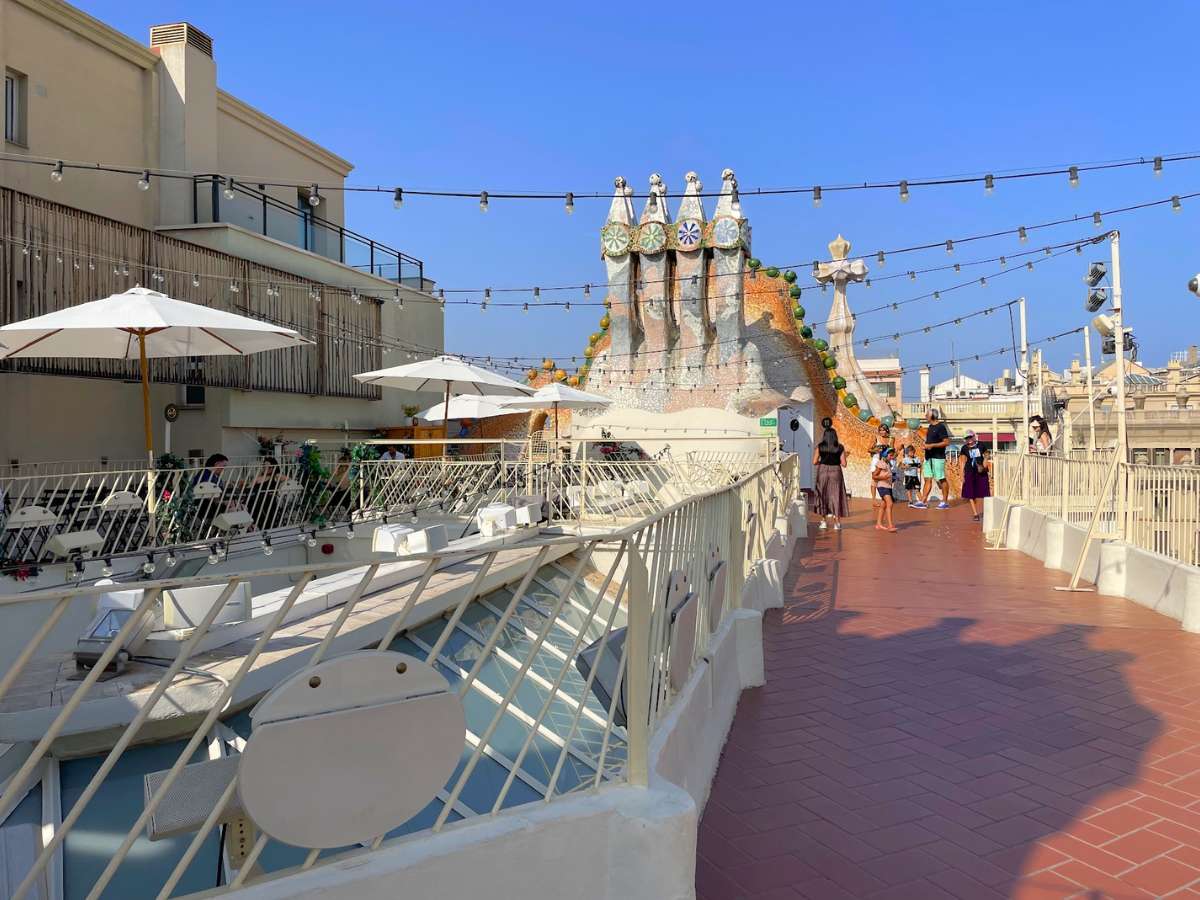
Casa Milà Rooftop
Casa Milà’s rooftop is much larger and definitely more dramatic. And it’s the real highlight of the building.
It’s filled with sculptural chimneys and ventilation towers that look like giant stone warriors.
Each structure has a different design, and the rooftop also offers some really nice views over Barcelona.

Casa Batlló vs Casa Milà: Night Visits
Both Casa Batlló and Casa Milà offer night visits, and they’re actually a really fun option if you’re looking for things to do in Barcelona at night.
Casa Batlló Night Visits
Casa Batlló’s night visit starts in the evening and is usually a bit cheaper than daytime tickets.
You’ll go through key parts of the house like the main floor, light well, and attic, and it includes a glass of cava.
They also host “Magical Nights” on the rooftop during certain times of year, with live music and drinks, which is a fun option if you want something more social.

Casa Milà Night Visits
Casa Milà’s night experience is more of a full production.
The rooftop turns into a full-blown audiovisual show with light projections and music that bring the building to life while you learn more about the design and history.
It’s a little more structured, but definitely memorable if you’re into that kind of experience.

Casa Batlló vs Casa Milà: Costs
Here’s a breakdown of how much Casa Batlló and Casa Milà tour tickets cost:
Casa Batlló Tickets
General Visit: From €29
- Daytime tour
- Audio-guided tour
- Access to the rooftop and the Gaudí Cube
Morning Visit: From €45
- Early morning tour
- Audio-guided tour
- Access to the rooftop and the Gaudí Cube
Night Visit (Seasonal): From €39
- Nighttime tour
- Audio-guided tour
- Welcome glass of cava + Special ambiance
Magical Nights (Seasonal): From €59
- Evening tour
- Live concert
- Audio-guided tour
- Access to the rooftop
FYI: For the general visits, Casa Batlló offers a Basic Blue ticket, as well as upgraded Silver, Gold, and Platinum ticket options, which include additional attractions like the Dragon’s Rooftop, the Gaudí Dome, the original Concierge room, an augmented reality tablet, the Private residence of the Batllós, and free cancellation.

Casa Milà Tickets
La Pedrera Essential: From €25
- Audio guide
- Access to the rooftop
- Explore the Whale attic
- Visit old tenant’s apartments
- Spend time in the flower courtyard and butterfly courtyard
La Pedrera Premium: From €120
- Small-group guided tour in English
- Access to the rooftop
- Explore the Whale attic
- Visit old tenant’s apartments
- Enjoy exclusive access locations like the Gaudí Room, auditorium, private interior balcony, and mezzanine
- Glass of cava
La Pedrera Night Experience: From €39
- Guided tour starting from 9:20PM
- Rooftop show
- Audio-visual screenings
- Glass of cava
La Pedrera Sunrise: From €39
- Guided tour at 8:00AM
- Access to the rooftop
- Explore the Whale attic
- Visit old tenant’s apartments
- Spend time in the flower courtyard and butterfly courtyard
- Visit the Gaudí Room and auditorium (former garage)
🤑 Get 5% off Essential tickets using the coupon code PEDRERASUMMER5. Offer ends on September 13, 2026.

Casa Batlló vs Casa Milà: Location

Tips for Visiting the Gaudí Houses
Before visiting Casa Batlló and Casa Milà, here are a few tips to make your visit easier:
- Consider purchasing the Barcelona Card: The Barcelona Card is a popular tourist card that can save you a bit on admission to both Casa Batlló and Casa Milà, as well as other popular Barcelona attractions. It also includes public transportation, which is helpful if you’re planning to visit multiple sights.
- Buy your tickets online in advance: These are two of the most popular sights in Barcelona, and lines can get long. Booking online is a bit cheaper and lets you skip the ticket line. You can book on the Casa Batlló official website and the Casa Milà official website.
- Get there early: Mornings are less crowded, which makes a big difference when you’re trying to actually enjoy the space and take photos. Just keep in mind that the early morning tours can be slightly more expensive.
- Consider the nighttime experiences: If it fits your schedule, the nighttime experiences are worth considering. The lighting, smaller crowds, and rooftop events give it a completely different feel.

Visiting the Gaudí Houses: FAQs
Here are some of the most frequently asked questions about the Gaudí houses:
How far apart are Casa Milà and Casa Batlló?
Casa Milà and Casa Batlló are within a short walk of each other. They’re only about 5-7 minutes away from each other on foot.
Which is the best Gaudí building to visit?
La Sagrada Familia is definitely Gaudí’s grandest and most famous work.
Why is Casa Batlló so famous?
Casa Batlló is famous for its unique and colorful exterior. It perfectly showcases Gaudí’s wild imagination and is one of his most notable works.
How much time do I need in Casa Batlló?
I’d recommend spending about 1-2 hours at Casa Batlló depending on which level of ticket you choose. This will give you enough time to fully appreciate the building’s details and take your time exploring the rooms, rooftop, and gift shops.
How much time do I need in Casa Milà?
I’d recommend spending about 1-2 hours at Casa Milà, depending on the ticket you’ve purchased.

Final Thoughts: Casa Mila or Casa Batllo?
I hope this guide helped you figure out whether Casa Milà or Casa Batlló is the better fit for your trip!
I’d recommend Casa Batlló for first-time visitors, but honestly, you can’t go wrong with visiting Casa Milà either. They’re both really unique and give you a completely different look at Antoni Gaudí’s work.
And if you do decide to visit, definitely consider purchasing the Barcelona Card, which will give you a discount on your visit.
No matter which one you pick, I think you’ll be really impressed by Gaudí’s incredible architectural style and vision.
READ NEXT:

